Politicians shouldn’t make promises. That is especially true for Councillor candidates as it requires the support of majority of Council to move items forward.
As a candidate with 8 years of Council experience, I think it’s important to present a platform that clearly connects to motions, decisions, and priorities from my years around the table. I’m proud to be judged on what I’ve helped accomplish.
Priorities
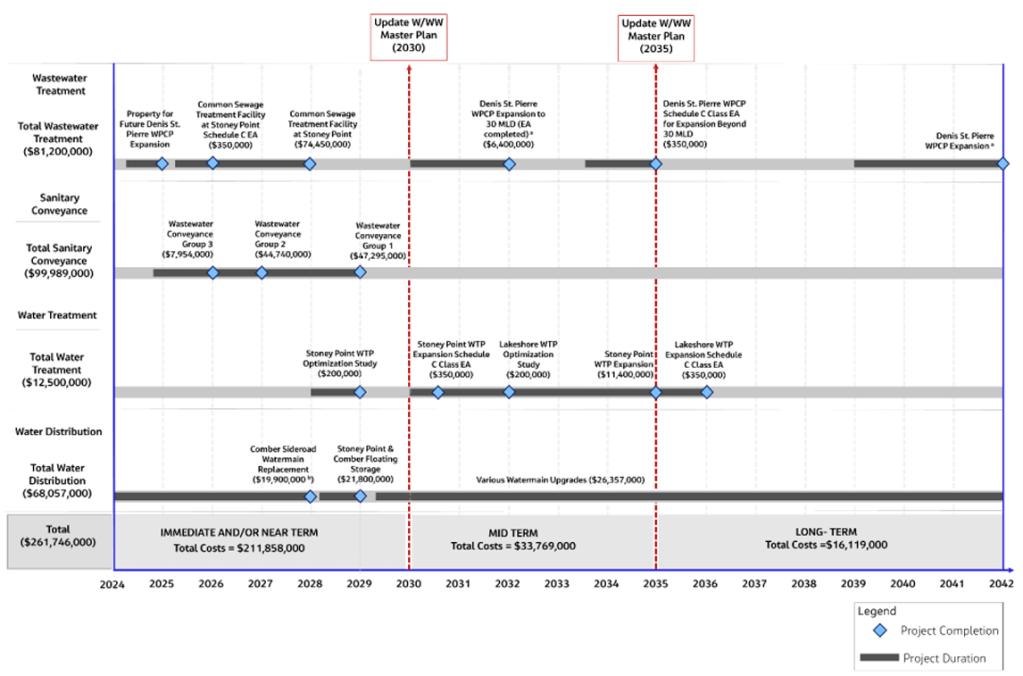
On May 12, administration presented an update to Council related to our ongoing engineering and infrastructure projects specifically related to water and waste water. As many of these initiatives are now tied to funding received from the Provincial and Federal governments, they are also tied to specific timelines and outcomes.
This most recent term of Council, we set the stage for infrastructure that will update aged and outdated infrastructure, and will help us grow. We now have several major projects planned from now until 2042 that address waste water treatment, waste water conveyance, drinking water treatment, and water distribution.
The next Council needs to ensure that Team Lakeshore stays staffed appropriately to manage these projects alongside all engineering priorities and initiatives directed by Council. We need to continue looking for external funding support to continue reducing the burden on taxpayers.
Attainable housing looks different for every person and family. Seniors on a fixed income, first-time homebuyers, single-parent households, and multi-generational families all call Lakeshore home. Thinking about and outside of the traditional single family unit, we need to be creating opportunities for everyone to call Lakeshore home.
This is personal. Looking for my first home, and being out-bid once again, a realtor that my money wouldn’t buy Lakeshore. I was already elected and serving on Council, working another full-time job, with savings in the bank. It took years, countless listings, walkthroughs, tears, a handy family, and a lot of elbow grease to make my first home possible.
This past term, we updated our Housing Needs Assessment and Affordable Housing Strategy. We secured Housing Accelerator Funding, launched a Housing Community Improvement Plan, and have expanded policy to allow for accessory dwellings. I have consistently voted in favour of the decisions that have helped us to expand what we build.
Development Charges
You’ve likely read that upper levels of government are trying to get municipalities to reduce Development Charges (DCs). These DCs are charged on most development projects to help cover the cost of growth. In most cases, only a percentage of a future investment’s cost can be attributed to growth. The best way to reduce DCs is to be clear about what infrastructure we will need to grow, or will be needed once we’ve grown. Having these projects identified, prepared for, or designed, makes us closer to “shovel ready” or “grant ready”. Then, when funding becomes available, we can reduce the DC portion accordingly, as well as the burden taxpayers or rate payers would have assumed for that project.
Wallace Woods Secondary Plan
The lands between Puce Rd and Patillo Rd could be home to over 20,000 residents once built out over the next 50+ years. It will need to be home to new schools, community services, employment opportunities, and commercial lands. The plan will be laid out through a formal Secondary Plan.
In 2022, Lakeshore received an initial report from WSP on the future of the Wallace Woods Secondary Plan. While the Secondary Plan will hopefully be finalized by the next Council, it is incredibly important that we have innovative minds at the table if we plan to develop a new community from the ground up in a way that doesn’t repeat the problems of the past.
Accessible sidewalks and trails are good for every body.
As a member of the Accessibility Advisory Committee, and as a mom pushing a stroller, I know the importance of these sidewalk connections and lifecycling. New sidewalks are wider, are at a lower risk of flooding, and are even surfaces. This is the difference between walking behind or beside family members and helps avoid tripping and getting wheels stuck.
Since I was first elected, I have made multiple successful motions to expand funding for sidewalks and trails during budget deliberations. In the last 4 years, we have introduced a sidewalk missing links program to better connect sidewalks in existing neighbourhoods. We have also expanded annual funding to replace sidewalks during lifecycle maintenance.
With the missing link program successfully in place for a few years, we should be working towards presenting a 5 year plan that ensures we have assessed and categorized our assets to ensure projects connect neighbourhoods, and ensure accessibility across Lakeshore.
Ongoing pedestrian projects in Ward 4:
- Ruscom River Loop (County Rd 31 & West Ruscom River Rd) (County & Lakeshore Project)
- Seasons Creek Access to Notre Dame (Lakeshore Project)
Context
Lakeshore’s parks are categorized into parkettes, neighbourhood, community, and regional parks, with our two regional parks being the Atlas Tube Recreation Centre (ATRC) and Lakeview Park & West Beach.
While we have been able to add small improvements over the past term, we need to define a longer-term vision and commitments.
Council has accepted the reports and Master Plan concepts for information and chose not to proceed with detailed design in entirety at this time. That’s a smart move. It avoids spending tens of millions of dollars now for plans that may need to be adapted before construction as the community changes and new funding or innovative ideas are brought forward to support implementation. It also means that we don’t sit on outdated costing projections, and can plan for more realistic budget allocations as we work in phases.
Master Plan Concepts
Lakeview Park & West Beach
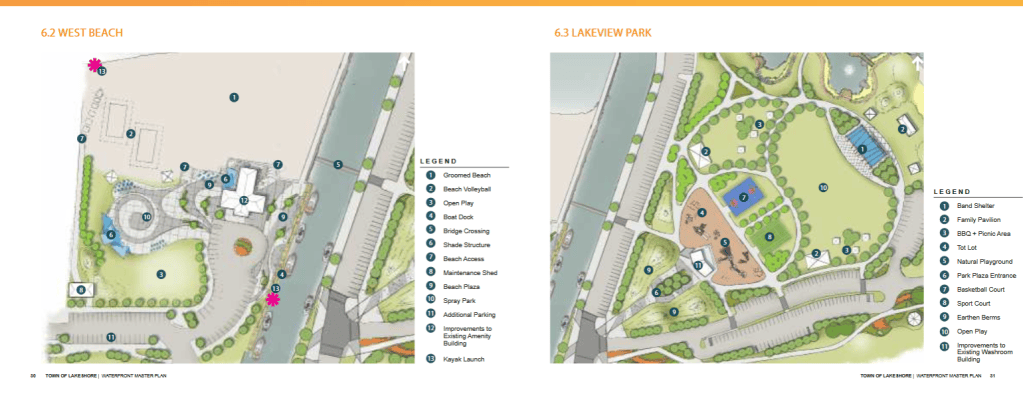
In 2020, Council accepted the Lakeshore Waterfront Master Plan for information.
In 2024, we had launched the Lakeshore Spark project, with the hopes of securing private investment at Lakeview Park. This would have maintained Lakeshore’s ownership over the property, and control over outcome, but would have alleviated the burden on taxpayers by securing external investment in a new building, which could have included a restaurant, cafe, or other proposal for council’s consideration. Unfortunately, it received no bids.
In 2026, we had to make the difficult decision not to renew a lease for the marina restaurant. The fire escape was no longer safe, and with the building also not accessible, we needed to take the time to figure out what our next step was going to be.
I know I am not alone in wanting to see us capitalize on our beautiful waterfront. After spending 4 years with my sister as co-owners of the West Beach Snack Shack, I know how special Lakeview Park & West Beach are. They are places for families to come together, unwind, and enjoy some of the best sunsets. I want to make sure that the opportunities we pursue reflect what the community wants to see at our waterfront. And, if the long-term vision is out of reach for now, we need to look at micro-investments and opportunities to spark activity that benefits everyone.
A new accessible building at the pier years away? Let’s investigate stationary or mobile food trucks. Leamington has explored this option and it is working very well!
Ongoing projects:
- 2026 Budget – We will conduct a parking study for the Waterfront Regional Park to assess current capacity, usage patterns, and future demand. The study will identify opportunities for improvements to support park visitors, special events, and anticipated growth, ensuring efficient and safe access for all users.
- 2026 Budget – We will develop a concept plan for the Belle River Marina building and launch area. The plan will assess current conditions, identify opportunities for improvements, and provide design options to guide future investment and development. The concept design will include public consultation after a preliminary scope of work is presented to Council for consideration.
- 2026 Budget – This project will address lifecycle replacements and upgrades at Lakeview Park. The splash pad requires new cement and water features, reusing the existing drainage system, at an estimated cost of $400,000. The play structure will be replaced with a new surface and structure to improve safety, accessibility, and connectivity to the splash pad, at $150,000. The park restrooms will be updated to maintain functionality and meet current standards, at $50,000. Together, these improvements enhance the recreational experience and overall usability of Lakeview Park. $600,000
Atlas Tube Recreation Centre (ATRC)
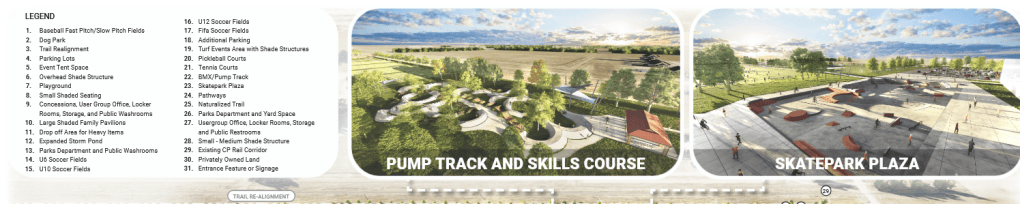
In 2025, Council accepted the ATRC Master Plan for information. See that agenda here.
Ongoing projects:
- September 2026 Council Meeting – Directed Administration to pursue two new designs for upgraded pickleball courts at the ATRC. The new concepts will include 12 courts (from our current 6 and 3 tennis) and will be a complete replacement of the existing facility, with an option to put a shade structure above. The next Council will make a determination on what will officially be built once we hear back on grant application successes and official construction cost estimates.
How do we pay for it?
Depending on on the type of park and the community in which its located, we have multiple ways of funding park upgrades and asset replacements. In our rural communities, we have been able to leverage Hydro One investment dollars, or funds we receive as hosts of windmills. We have also made use of the Ontario Community Infrastructure Fund (OCIF) grants in the past. This is in addition to any tax base contributions and what we receive through development as parks dedication fees when we accept payment in lieu of land.
Where can we leverage additional funding?
Naming rights: We can look to the public and private sectors for investment in naming new facilities or assets. This can be big and small. From the bench dedicated to a love one, to the name of a pavillion or facility, there should be opportunities for everyone. The naming policy is due back by end of Q1 2027.
Municipal Accommodation Tax (MAT): Lakeshore Council has proposed a 6% MAT be applied to stays at Lakeshore’s hotels (Holiday Inn Express at Manning). These revenues, according to provincial requirements, need to be split between the host municipality and tourism agency. In our case, it will be TWEPI. I made a motion this year that Lakeshore’s share of the revenues be allocated 70% to a new Regional Parks Reserve and 30% to the existing Economic Development Reserve.
Support the Campaign
Host a lawn sign from now until October 27th! Fill out the form here.
Is there an issue that you, your neighbours, or your community group are passionate about. I am happy to come meet with groups, organizations, and neighbours from across the ward. Get in touch and we can schedule something soon!
Donations are accepted by e-transfer to hello@ksantarossa.ca. Donation receipts will be issues upon receipt, so please include your contact information in the comments of your transfer!
Election Surveys
Bike Windsor-Essex Survey Responses
I’ve been getting out to knock on doors and talk to residents across Ward 4 to hear more about what they’re looking for over the next 4 years. Check back for more updates!
Curious about my unfinished business or things I wish would have turned out differently? See below.
Caille Avenue has been a long-term priority. I think we can all recognize that Caille Ave needs a separate path for pedestrians. The safest thing we can do is get people off the road.
Since we know that pedestrian infrastructure will be part of road reconstruction, I have had the support of Council and administration to pilot new strategies to address issues like speeding. Caille Avenue the first street in Lakeshore to receive the digital speed radar signs I saw demonstrated at AMO in 2019. We also successfully pursued designation as a Community Safety Zone, allowing for increased speeding fines.
Following an updated speed study, we introduced seasonal bollards as another traffic-calming measure. Unfortunately, the bollards were repeatedly stolen, destroyed or vandalized, making that approach unsustainable.
We also applied for funding to create a sacrificial trail that could have improved pedestrian and active transportation connections while working around some of the challenges of a full reconstruction. That grant application was not successful.
Rather than move ahead without the community, we went back to residents to ask whether they wanted to accelerate work on Caille Avenue. While we were not yet financially ready for a full reconstruction, we could have advanced drainage and other components of the work sooner. As this would have resulted in higher costs, residents understandably told us they preferred to wait.
Now, in 2026, we are moving forward with the drainage report. This is the first step towards reconstruction. Lakeshore wants to move forward with the confidence that residents will support drainage improvements underground. This way, we can upgrade all infrastructure simultaneously without risking a new road for underground infrastructure that would have to be dug up in nearer future. My hope is that residents will support advancing this drainage work so that we can plan and budget for a full road reconstruction to the same standard we see on Lakeview Drive and Shoreline Avenue.
It has taken time, but I believe the right approach is to keep listening, keep working through the barriers, and keep moving the project forward rather than promise a quick fix that doesn’t solve the underlying problems.
Ontario updated its Heritage Act, updating the requirements for the designation
of listed properties with cultural heritage value or interest. If a municipality wishes to officially designate a property from 2027-2032, it must issue a notice of intention to designate prior to January 1, 2027.
Lakeshore has 69 listed properties, and while we know about some specific properties and their heritage or cultural value, we do not have many details on the dozens of other properties on our heritage list.
After much deliberation, our current council voted to receive a report instead of endorsing options to reinstate a heritage committee or contract a heritage consultant to learn more about the properties we could designate should they be worth protecting.
I am happy that a motion I made to contact the property owners to let them know that the deadline is approaching did pass, but I am nervous about the potential to lose parts of or any of these properties without knowing more about them. After the deadline passes, an owner of a once-listed property will no longer have to give Council a 60-day notice before demolishing the property. Council will lose the opportunity to use that period to consider whether the property should be formally designated. The property generally cannot be put back on the Heritage Register for five years.

